
How We Helped LNG Filters Make Inventory Management 10x Simpler with Google Sheets Automation
LNG Filters was tracking stock across hundreds of items, suppliers and projects using conventional records that were easy to lose. We built a custom inventory system on Google Sheets with automation, a dashboard and reports, tailored to how the company actually works.
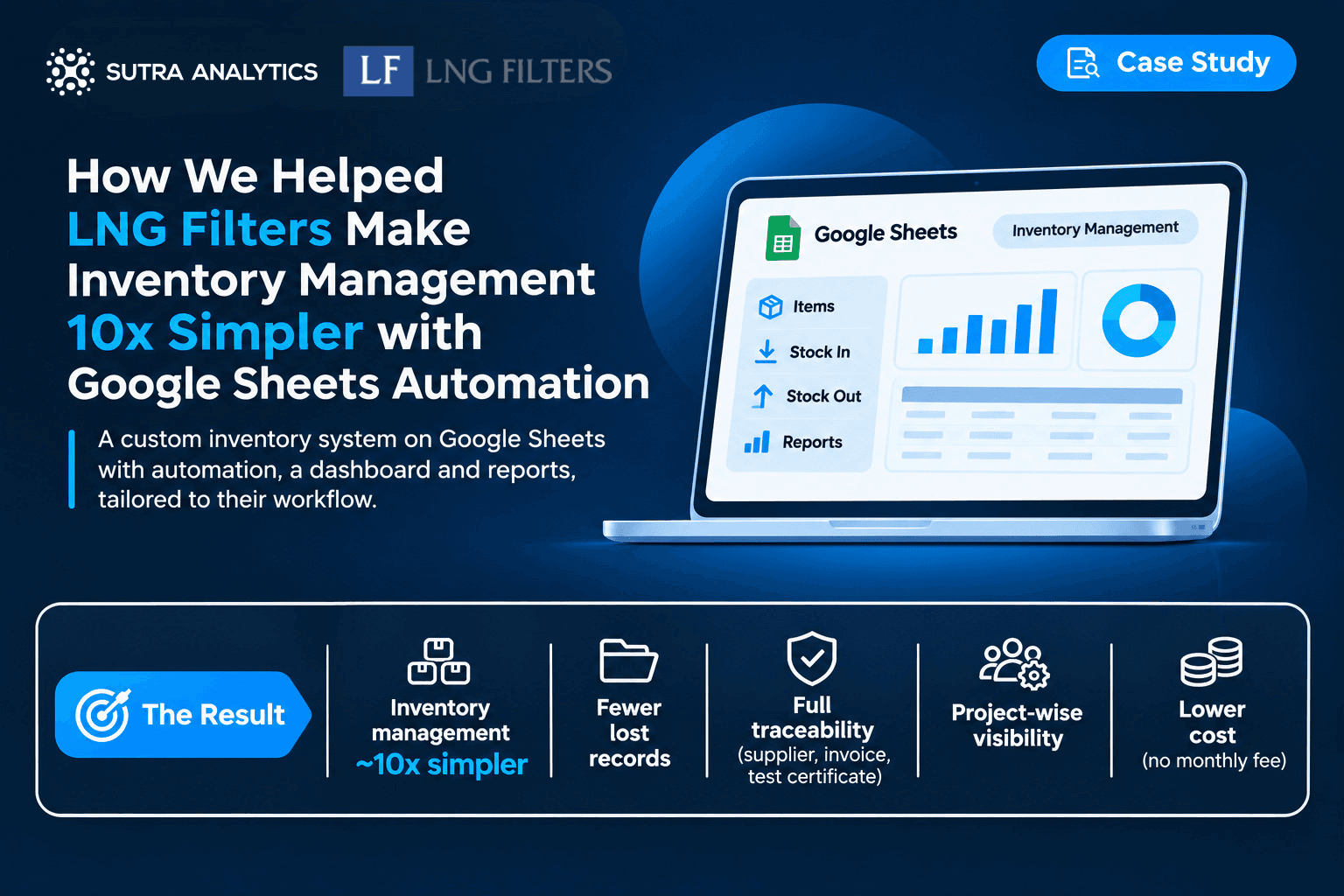
LNG Filters, an industrial filtration manufacturer in Ahmedabad, was finding it hard to track stock across many items, suppliers and projects. Records were easy to lose and hard to trace. Sutra Analytics built a custom inventory management system on Google Sheets, powered by automation, with a dashboard and reports, tailored to how the company works.
The Client
LNG Filters is a company based in Ahmedabad, Gujarat, led by Director Jay Patel. It designs and manufactures industrial filtration products for process industries in India and abroad, focusing on micron and macro filtration. Its range includes filter housings, cartridges, filter bags, strainer elements, dust collection filters and compressed air filters. It is also an authorised distributor of Graver Technologies in India.
Its work covers contamination from 0.1 to 1000 µm, and its product range is wide:
Product Range
- Liquid filtration systems: cartridge filter housings, bag filter housings and strainer housings.
- Liquid filtration consumables: spun bonded, wound and resin bonded cartridges, polymeric pleated cartridges, cleanable metallic cartridges, strainer elements and liquid filter bags.
- Air and gas filtration: pleated and conventional dust collection bags and pleated dust collection cartridges.
- Compressed air and gas filters, including compressed air line filters.
- Graver Technologies range: PTFE, polypropylene pleated, stainless steel sintered and polyethersulfone cartridges, supplied as an authorised distributor.
Every one of these products comes with its own item code, specification and supplier details, which makes stock tracking a bigger job than it looks. The company serves industries such as petrochemicals, oil and gas, textiles, paints and inks, fertilizers, water treatment, and paper and pulp.
The company makes standard or custom products at a reasonable price, working under a quality management system that runs from raw material buying to in-process checks. Its housings follow the ASME pressure vessel code, and a quality dossier ships with products for traceability. It also helps customers choose the right filter by analysing contamination, runs pilot scale trials, and inspects processes on site to avoid systems that are over-designed or under-designed.
The Problem
With many product types, specifications and industries, LNG Filters has a lot of stock to track by item code, supplier, invoice and test certificate. Operations were run the conventional way, and inventory management was getting harder over time. Records were easy to lose and hard to track, and traceability, which is central to this business, depended on them. For a company that works project by project and ships test certificates and quality documents with its products, a lost or incomplete record makes it harder to trace where material came from and where it went. Each new product line or supplier added to the problem.
What we built:
A custom inventory management system in Google Sheets with a dashboard, built specifically for LNG Filters. Automation handles the repetitive work: item names and units fill in by themselves, the live available quantity is calculated after every stock out, issuing more than what is available is blocked with an error, and every entry is recorded in the logs and reports.
1. Add New Item
- Each item is added once with its stock item code, description, unit of measurement, restock quantity and other details as needed.
2. Stock In
- When stock arrives, the team enters the entry date, supplier name, invoice number and date, quantity, value per quantity and test certificate number.
- The item code is picked from a dropdown of codes already added, and the item name and unit of measurement fill in automatically.
3. Stock Out
- When stock is issued, the team selects the item code and enters the quantity, the project it goes to and the date.
- The system shows the live available quantity after every stock out and gives an error if someone tries to issue more than is available.
- Because every stock out is tied to a project, the team can later see exactly which project received which material.
4. Product Master
- A master sheet lists all items with full details, including code, description and quantity.
- This is the single reference list for the whole inventory, holding every detail entered when each item was added, so the team can check any item in one place without searching through records.
5. Logs
- Separate Stock In and Stock Out logs keep every entry with full details for future reference.
- Stock In entries carry the supplier, invoice, value and test certificate details, while Stock Out entries carry the quantity and the project, so any past movement can be traced back whenever it is needed.
6. Reports
- Reports by GRN.
- Reports by project.
- Reports by item.
- On top of these, we built more interactive and complex reports inside the sheet for deeper analysis.
These reports are built from the same entries the team already makes in the forms, so there is no separate reporting work. The team can filter by what they need: everything received under a GRN, everything issued to a particular project, or the full history of a single item.
💡 Why Google Sheets instead of ready-made software: Ready-made inventory software charges every month and still may not fit a company's exact workflow. A system built in Google Sheets keeps the cost low: the work is a one-time development cost with small occasional maintenance, and there is no monthly fee because Google Sheets is free. Fields such as test certificate number, supplier, invoice details and project name were built in from the start, because they are part of how LNG Filters actually works.
The Result
As the client described it, inventory management became about 10 times simpler and more accurate, with fewer lost records. Day to day, each item is added once, every stock movement is entered in a simple form, and the sheets, logs and reports update from the same data. There is no searching through scattered records, and the team can look up any past entry in the logs when needed.
Benefits
- Simpler and more accurate: every stock movement is recorded once, in one place.
- Traceability: test certificate numbers, suppliers and invoices are tied to each stock entry.
- No stock errors on issue: the system prevents issuing more than what is available.
- Project-wise visibility: reports by project match how the company works.
- Lower cost: no monthly software fees.
- Built for their workflow: tailored to their process, from test certificates to project-wise stock issue.
Key takeaways
- A custom Google Sheets system with automation can replace conventional record keeping without recurring software fees.
- Dropdowns, automatic fields and stock checks keep data clean from the start.
- Reports by item, project and GRN turn daily entries into useful insight.
Is your business running on disconnected tools?
Sutra Analytics helps companies automate and connect their operations.