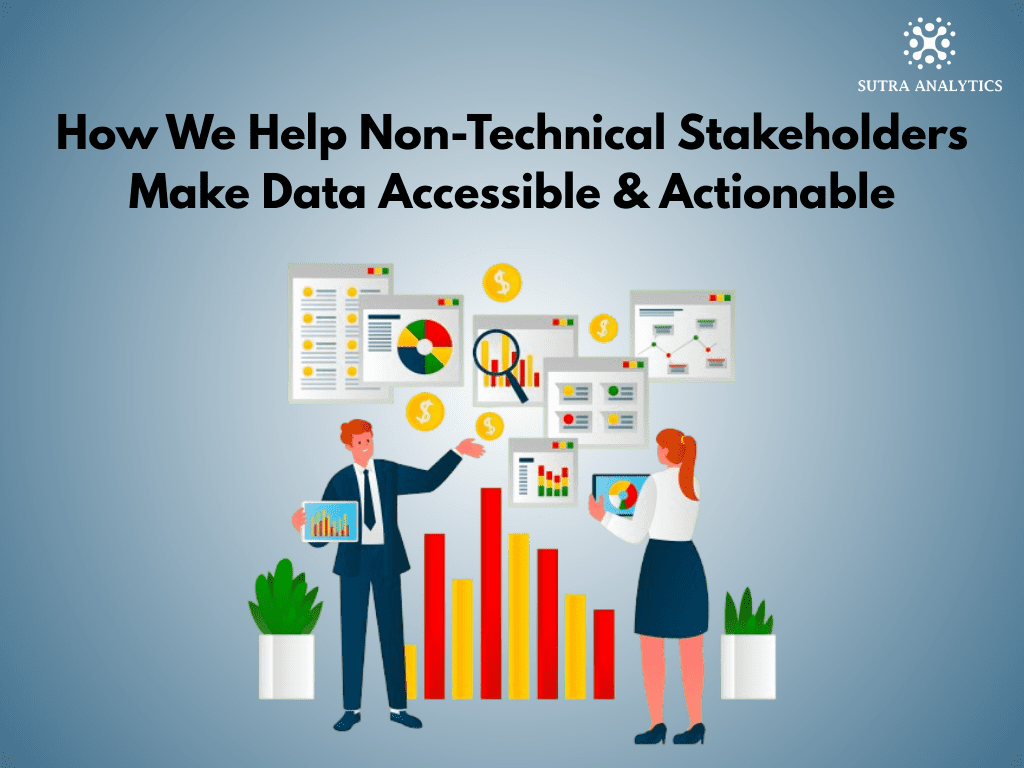
In many organizations, data is available—but it isn’t usable. Teams receive spreadsheets, raw reports, or complicated dashboards that only technical analysts can understand. As a result, managers, sales teams, marketing staff, and decision-makers struggle to interpret data and make confident business decisions.
At Sutra Analytics, we solve this problem by designing systems, dashboards, and analytics workflows specifically built for non-technical stakeholders. Our goal is simple:
Turn complex data into simple, visual, and actionable insights that anyone can understand in seconds.
Here’s how we do it.
1. We Translate Complex Data Into Clear, Business-Friendly Dashboards
Non-technical users don’t want to dig through large datasets or confusing charts. They want quick, reliable answers.
At Sutra Analytics, we build dashboards that:
- Show the most important KPIs upfront
- Use simple, intuitive visuals
- Highlight only what needs attention
- Use clean layouts without clutter
Whether it’s sales trends, inventory health, customer behavior, or project performance, our dashboards make insights instantly understandable, even for people with zero technical background.
2. We Use Plain Language Instead of Technical Jargon
Most analytics tools are filled with terms like “cohorts,” “retention curves,” “time-series anomalies,” or “segmentation logic.”
At Sutra Analytics, we replace all this jargon with:
- Simple labels (“Total Revenue,” “New Customers,” “Active Orders”)
- Clear explanations added directly on charts
- Tooltips that describe metrics in easy language
Our goal is to ensure that every stakeholder—sales teams, marketing teams, HR leaders, or executives—can confidently read the data without extra training.
3. We Design Dashboards Around Your Actual Business Questions
Instead of giving generic dashboards, we ask:
- What decisions do your teams struggle with?
- What numbers do they need daily?
- What slows down decision-making today?
Then we build a dashboard that answers those exact questions.
For example:
- Real estate teams get dashboards showing property inquiries, leads, site visits, and agent performance.
- Restaurants get dashboards showing table occupancy, weekly revenue, menu performance, and staff needs.
- E-commerce teams get dashboards on inventory, top products, customer lifetime value, and conversion funnels.
Every dashboard is built for business use, not technical analysis.
4. We Use Visual Storytelling, Not Just Charts
A dashboard should tell a story.
That’s why our dashboards include:
- Highlights
- Alerts
- Notes and annotations
- Comparisons with previous periods
- Color-coded indicators
This helps non-technical stakeholders see:
- What changed
- Why it changed
- Whether it’s good or bad
- What they should do next
Data becomes a story—not just numbers.
5. We Automate Data Refreshing to Avoid Manual Work
Non-technical users often get stuck updating spreadsheets or merging reports.
Sutra Analytics automates:
- Data collection
- Cleaning
- Combining
- Updating
- Visualization
This means:
- No more manual Excel work
- No more downloading reports from multiple places
- No more late or inaccurate data
Users always see fresh, real-time information without touching the backend.
6. We Offer Training and Support Focused on Non-Technical Teams
Our job doesn’t end with delivering dashboards.
We also provide:
- Live training sessions
- Step-by-step video guides
- Clear documentation
- Ongoing support
We ensure that every member of your team knows exactly how to use the dashboard—without getting overwhelmed.
7. We Customize Dashboards for Each Role in Your Company
Different teams need different views. A CEO doesn’t need the same dashboard as a sales executive.
We create role-based dashboards such as:
- Executive Dashboards
Big-picture KPIs and performance indicators - Operations Dashboards
Daily activity, workload, order status - Marketing Dashboards
Campaign metrics, leads, conversions - Finance Dashboards
Spending, revenue, forecasting
This ensures that every stakeholder gets only the information they need, nothing extra.
8. We Make Data Truly Actionable
Our dashboards include:
- Benchmarks
- Targets
- Goal tracking
- Forecasting
- Automated insights
This makes it easier for non-technical teams to act quickly and make smarter decisions.
Instead of asking “What does this mean?”, they get dashboards that clearly say:
- “Sales dropped 12% this week—here’s why.”
- “Inventory is running low—reorder recommended.”
- “Campaign A performed better—shift budget here.”
This is where data truly becomes power.
Conclusion: Making Data Simple Is Our Expertise
At Sutra Analytics, we believe data should empower everyone—not just analysts.
By simplifying dashboards, removing jargon, using visual storytelling, and building role-based insights, we help businesses transform data into clear, actionable decisions for every stakeholder.
Whether you are a business owner, team leader, or entire organization, our analytics solutions ensure that your data works for you—clearly, simply, and effectively.